
Essential Concepts
Welcome to Bitcoin self-custody.
Before beginning the hands-on lessons, this chapter explains the minimum theory you need to understand self-custody properly.
1️⃣ Why Should You Hold Bitcoin Yourself?
Bitcoin is an asset that anyone can own and manage directly. If you leave it on an exchange because self-custody seems complicated or withdrawal fees feel wasteful, you are giving up part of your financial sovereignty.
Bitcoin held on an exchange is effectively a number in the exchange's internal ledger. Exchanges can be exposed to hacking, technical failures, dishonest insiders, and other threats. When your bitcoin remains there, those risks become yours. Many people have lost access to bitcoin through security incidents and unexpected account freezes.
Exchanges are also affected by regulation and apply their own policies to control and monitor customer assets. Anyone who has withdrawn bitcoin from an exchange will recognize the inconvenience of excessive personal-information requests and slow, complex procedures imposed in the name of preventing money laundering.
Bitcoin self-custody is not only about protecting an asset. It is about protecting your financial sovereignty and retaining the right to control your property completely. By understanding Bitcoin and wallets more deeply, you can follow a safer and more independent path for managing your assets. The best person to protect your bitcoin is you.
Not your keys, not your bitcoin!
2️⃣ Where Is Bitcoin Actually Stored?
- In a wallet
- In a distributed public ledger
If you chose either answer, keep reading.
Every Bitcoin transaction is recorded in a public ledger maintained by participants across the Bitcoin network—full nodes. The ledger records how bitcoin moves between addresses and, ultimately, the total value of the UTXOs (Unspent Transaction Outputs) associated with each address. Anyone can inspect this information.
However, nobody can simply pretend to own bitcoin recorded in the ledger. To prove ownership and spend it, you need the corresponding private key.
- Private key
- A secret key used to prove control of bitcoin.
- Spending the balance associated with an address requires signing a transaction. That signature proves that the owner authorized the transaction.
- Public key
- A key paired with the private key and used to derive addresses.
- Unlike a private key, it can be shared safely and is used to verify transaction signatures.
A Bitcoin wallet is simply a tool that manages these private and public keys and makes it easier to interact with the Bitcoin ledger. Bitcoin is not physically contained inside the wallet. A better way to understand it is that the private key grants the authority to move bitcoin.
3️⃣ What Is a Mnemonic Phrase?
Early wallets provided a collection of unrelated private keys to avoid reusing addresses. If a wallet held 100 keys, backing it up meant copying all 100 correctly. This was inconvenient and dangerously error-prone.
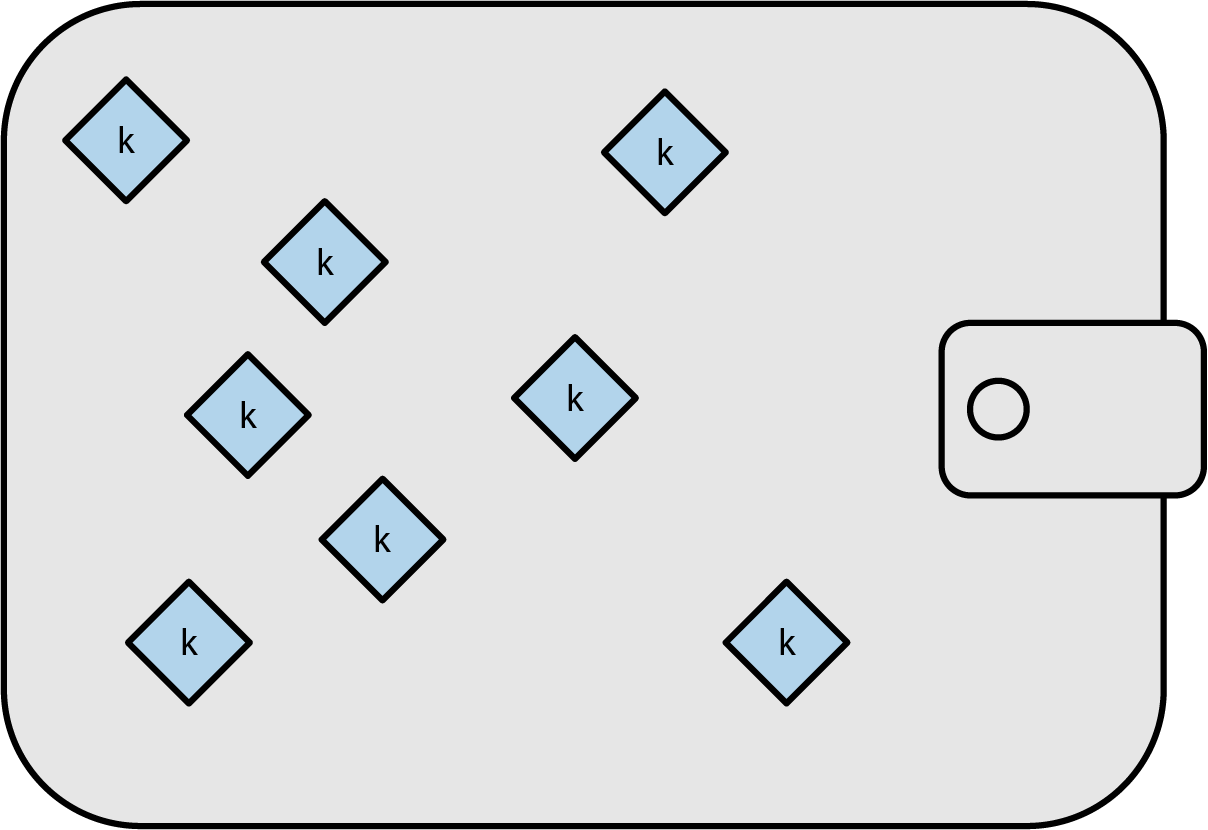
Early Bitcoin wallet (Source: Mastering Bitcoin, 3rd edition, Chapter 5, Figure 1)
Several improvements were proposed to make wallets easier and safer to manage. Eventually, BIP standards[1] made it possible to generate many keys from a single seed.[2]
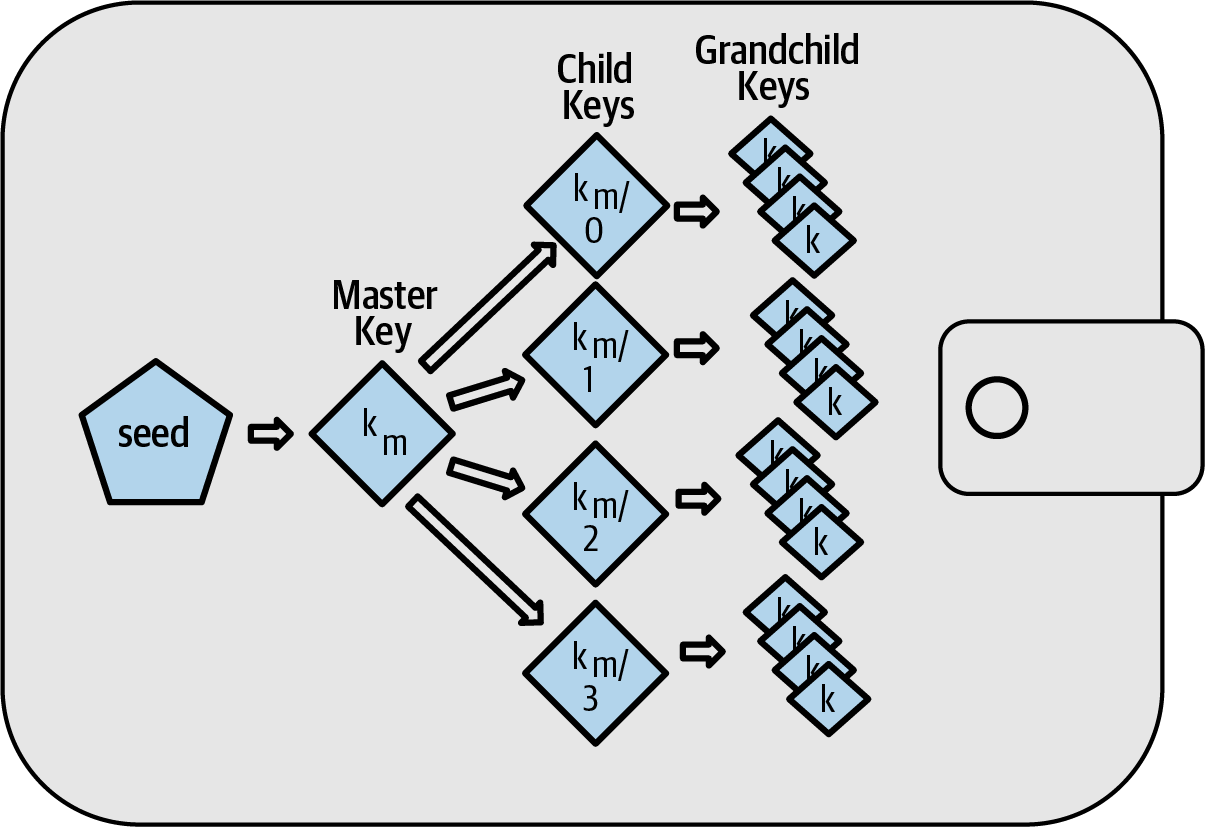
A wallet that generates many keys from one seed (Source: Mastering Bitcoin, 3rd edition, Chapter 5, Figure 3)
As the diagram shows, many keys can be generated from one seed. Backing up the seed backs up every key. Conversely, losing the seed means losing every key, so protecting it is critical.
Seeds were still difficult for people to record accurately. The mnemonic phrase standard solved this by representing the information needed to create a seed with familiar words. “Mnemonic” means a device that helps memory.
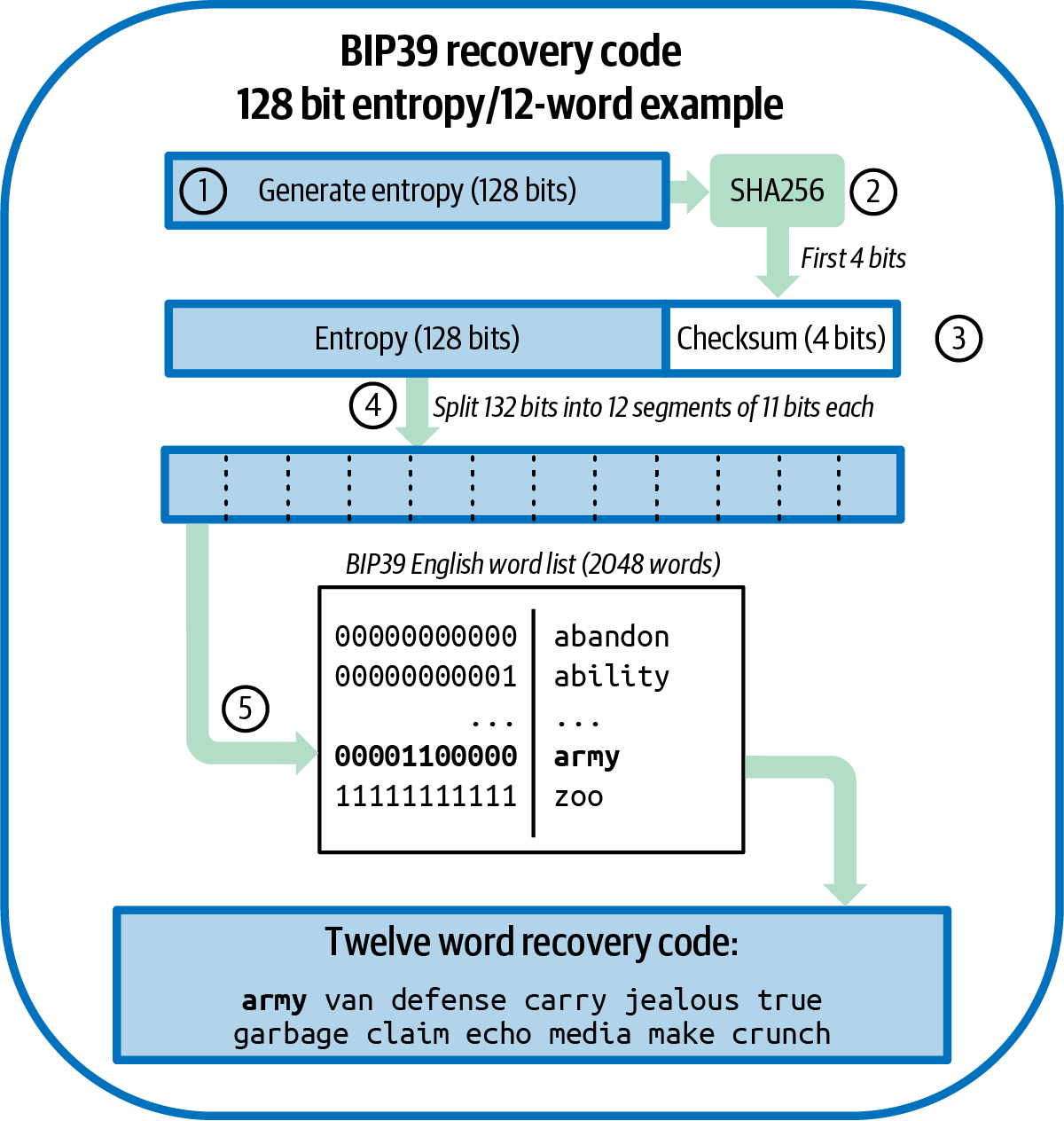
A standard that connects seed-generating entropy to words (Source: Mastering Bitcoin, 3rd edition, Chapter 5, Figure 4)
Mnemonic phrases have since become the standard way to back up seeds in most cryptocurrency wallets.
Further learning: important wallet standards
Summary
Use the diagram below to review the relationship between a mnemonic phrase, private keys, and public keys.
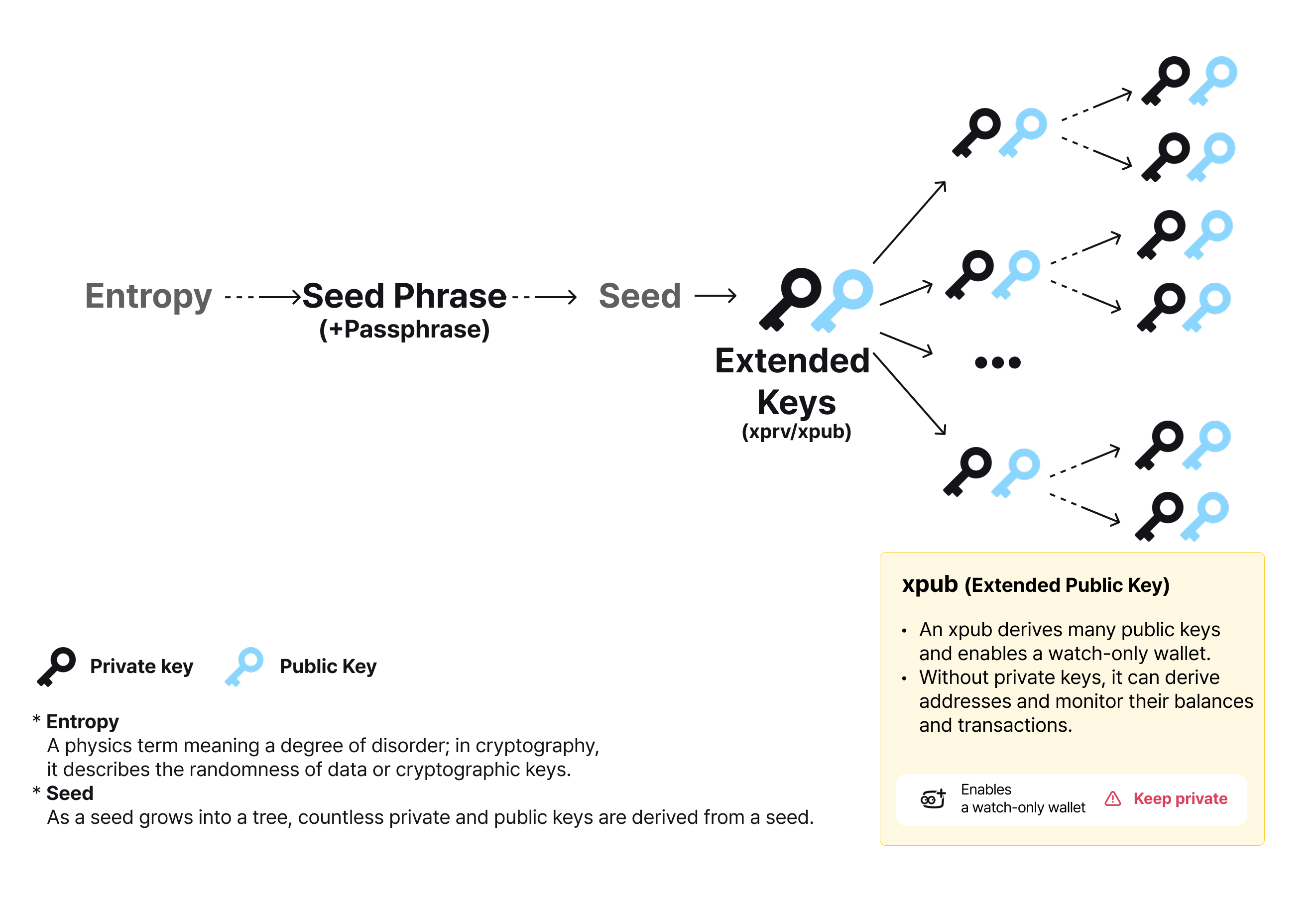
The relationship between a mnemonic phrase, private keys, and public keys
The central lesson is simple: protecting your mnemonic phrase is the heart of Bitcoin self-custody.
Wherever you are—even if the wallet you used is damaged—your bitcoin remains safe as long as your mnemonic phrase is securely backed up.
For information about passphrases, see Create with Coin Flips.