
Understanding Multisig Wallets
Before using a multisig wallet, learn the basic concepts behind it.
Multisig is a powerful way to improve security and resilience. It can help individuals, families, and organizations safeguard and manage bitcoin. To use it safely, however, you must understand how it is configured, operated, and recovered.
1️⃣ What is a multisig wallet?
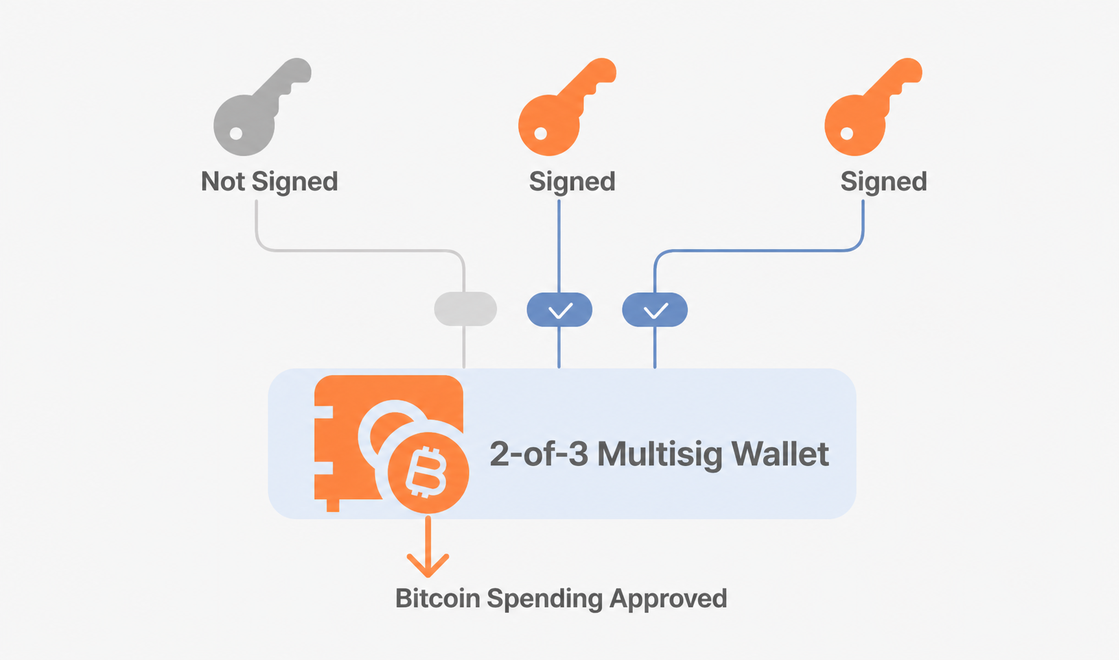
A standard wallet signs a transaction with one private key, so it is also called a single-signature wallet. A multisig wallet requires multiple signatures and is described as an m-of-n multisig.
Here, n is the total number of keys, while m is the number of signatures required to spend. For example, a 2-of-3 wallet requires signatures from any two of its three keys.
2️⃣ Benefits of multisig ➕
- Stronger security
Requiring two or more keys prevents a thief from spending the funds after compromising only one key. In a 2-of-2 wallet, for example, one stolen key is not enough. - Distributed authority
When several people jointly manage bitcoin, no single key holder can move funds unilaterally. A 2-of-3 wallet can require majority approval, while a 2-of-2 wallet requires both participants. - Lower risk from a lost key
Some configurations remain recoverable when one key is lost. In a 2-of-3 setup, for example, you might hold two keys and entrust one to another party; losing either one of your keys would still leave two usable keys.
3️⃣ Tradeoffs of multisig ➖
Slower operation
Gathering the required signatures can reduce flexibility when a payment is urgent.
Higher fees
Multisig transactions generally contain more signature data, increasing transaction size and potentially the fee.
More complex key management
Keys need to be stored separately and a recovery plan is essential. Losing too many keys can make the bitcoin permanently inaccessible.
Compatibility considerations
Not every wallet or service supports multisig, and some may be unable to process multisig transactions.
4️⃣ Multisig safety checklist ⚠
Distribute the keys
Do not keep every key with one person or at one location.
Plan backups and recovery
If fewer than m keys remain recoverable in an m-of-n wallet, the funds cannot be spent. Diversify backups across paper, hardware, or encrypted storage.Choose key custodians carefully
If a third party holds a key, use someone you trust and choose the threshold so that party cannot misuse the funds.Understand the setup
Multisig is more complex than single-signature custody. Understand its purpose and workflow, and send a small test transaction before committing real funds.
5️⃣ Which m-of-n setup should I use?
- A small group of trusted parties: 1-of-2 or 2-of-2
- 1-of-2 — either participant can authorize a transaction.
- 2-of-2 — useful for jointly managed funds; both participants must sign.
- Reducing an individual's loss risk: 2-of-3
- Key 1 — kept with you
- Key 2 — physically backed up and stored securely
- Key 3 — entrusted to a trusted third party or stored at another secure location
- This preserves access if either Key 1 or Key 2 is lost.
- Larger setups such as 3-of-5 are generally better suited to companies and organizations.
The key is to balance security with operational practicality.